Force of Good

Quote of the Week

Jun 18, 09 in Quotes   4 Comments

"'Social networks' may be a popular buzzword these days, but the whole concept of the internet was based on social networking from the start -- going all the way back to bulletin boards, email, and forums right up to today's blogs, social networking sites, and, yes, Twitter. As far back as 1978, bulletin board systems were essentially doing the same thing that modern networks are doing. The big difference now is that the usability and usefulness of the newer networks are infinitely better."

Jason Clark

I made my way to Jason's article via an eMarketer piece called "Time to Write Twitter's Tombstone?"  I don't think that's the case.  I do think that social networks are fashion.   They come and they go.  Jason believes that Google Wave will make Twitter obsolete.  Perhaps.  I like the concept of Wave a lot.  Keith McGreggor and I came up with a concept very much like Wave.  We called it The Greatest App Never Built.  Here's the pitch:

The Greatest App Never Built will solve the information overload problem of all your Internet communications. It will take your email accounts, RSS feeds, social networking communications into a simple interface and then sematically sort them not based on date or read/unread status but by how much attention they deserve based on your past behavior.

Still a good idea.

But back to my point.  Social networks are fashion.  People tire of them.  They are too hard to manage.  All the marketers come in.  They get spammy.  It is easier to move on to the next thing instead of scrubbing all the stuff within a particular network. And just leave it there.  An artifact of a bygone era.  Social networks have no staying power.

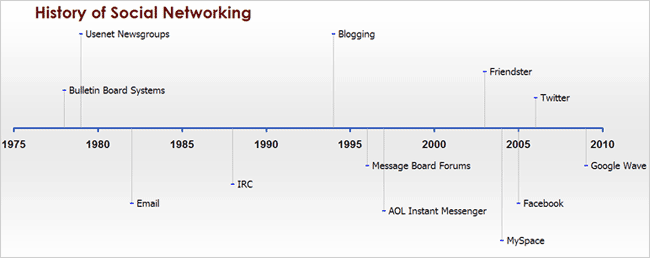
There is something else that is going on as well.  Something that Jason confused a bit.  Below is Jason's history of social networking graph.

090615_pg1_img1_timeline_lrg

There is a difference between the application layer of the Internet protocol suite and an Internet application.  Usenet (NNTP), Email (POP3, SMTP & IMAP), and Internet relay chat (IRC) are part of the core Internet application protocol suite.  Therefore they have tremendous staying power.  All of the social networks that have emerged since 2000 are not part of the core Internet application protocol suite.  All these social networks applications are built within the HTTP Internet protocol.  The social network applications are not as fundamental as the earlier Internet protocol suite applications.  Take another look at the chart.

Internet protocol suite applications are like underwear.  Have not changed much since the 1980s.  Social networks are like fashion.  They change every few years.

Comments

You haven't changed your underwear since the 1980's? Oh my.


Sorry, had to ;)

Brian Culler  |  Jun 19, 09 at 02:48 PM

I agree at a high level with the premise of your points regarding core protocols vs. applications but think they are really more of a guideline than a rule. Being a core Internet application protocol does not always ensure longevity; anyone remember Gopher? (http://www.rfc-editor.org/rfc/rfc1436.txt)

Supporting your point, the key differences between a core Internet protocol and an Internet app is the former has been hashed out to consensus by many critical minds and is open to be freely used by anyone and the latter is typically controlled by a single entity and the app is subject to the rules imposed by that entity and the result of their vested interests. This leads the protocol to having more tenacity than the application in general but not always.

Core protocols only remain actively used as long as they remain both useful and there is no better alternative emerges regardless of them being a core protocol or application. It'd say IRC is a good example of a protocol that is only used by the most hardcore; far more people use forums, Facebook and Twitter. Google Search is an application yet it has proven staying power. Google Maps is another example.

As far as Twitter goes, I would agree that as a social network it will eventually fall out of a fashion and the next big thing will take over. But I don't believe at it's core Twitter is focused on being a social network. I think Twitter's team is working to turn Twitter into the real time status update equivalent of dial-tone. If that happens Twitter will cement itself just as readily as any core Internet protocol with the W3C or IETF possibly even taking action to standardize its API into a core Internet protocol just as they did with early HTTP and many of the early HTML extensions.

Also if Twitter becomes "dial tone" it will cease to be a thing we discuss and will become invisible like every other fully pervasive technology has in the past. Then we'll all be talking about Google Wave or something else yet Twitter will remain the transport for many of the status updates processed by Wave.

On the other hand, who knows? I could be totally whacked on all of this. But it'll be a fun ride watching it all, no? :)

Mike Schinkel  |  Jun 21, 09 at 04:07 AM

Mike good point.

I just find that social networking apps that try to become communication apps fail. I just responded to a LinkedIn "Request to Forward." It's easier using email.

I do think that Twitter could evolve into what you describe as "dial tone". But if it does I fear it will become like the AOL Instant Messenger in the chart. While it continues to lead market share in the United States it hardly seems relevant as the XMPP protocol is reaching the last stages of approval.

And it is very interesting to note that there is a Google Wave Federation Protocol before the product is on the market. It is an extension of XMPP. It's stated aim is "intended to parallel the openness and ease of adoption of the email protocol so waves may succeed email, as the dominant form of Internet communication."

Lance  |  Jun 22, 09 at 07:15 AM

Making Wave an extension of XMPP was definitely a wise move by Google. They have had limited success with selling Google docs SaaS to organizations as a MSFT Office alternative, mainly because of privacy/security concerns with proprietary data in the cloud and Google's control thereof. By making what is essentially their MSFT Exchange competitor something that can be put behind a firewall, they are increasing their chances of success. It doesn't hurt that Wave is an order of magnitude better than Exchange while Google Docs doesn't compare as favorably with Microsoft Office. I think it will still take at least a couple of years for federation to gain adoption.

Wave *is* more likely to become more important than Twitter, mainly because there's only so much you can express in 140 characters. They serve different needs. It also has the best chance of replacing email. There's nothing else out there that could.

I dispute the notion that Wave (without additions to what was demoed) will make a significant dent in the information overload problem. Yes, it will give you a single interface that integrates everything (email, IM, feeds..) but in the demo, all that stuff was still ordered by time.

Aarjav  |  Jun 23, 09 at 04:47 PM

Post a comment

Name:

Email Address:

URL:

  Remember me?
Comments: