That post the other day about room to grow in the mobile coupon space. From the Groupon Q1 earnings call this is what it looks like today for them, one of the leaders in local couponing. Sales via mobile have risen to 45%. There's gold in them devices.

Posted in Commerce, Deals, Mobile |
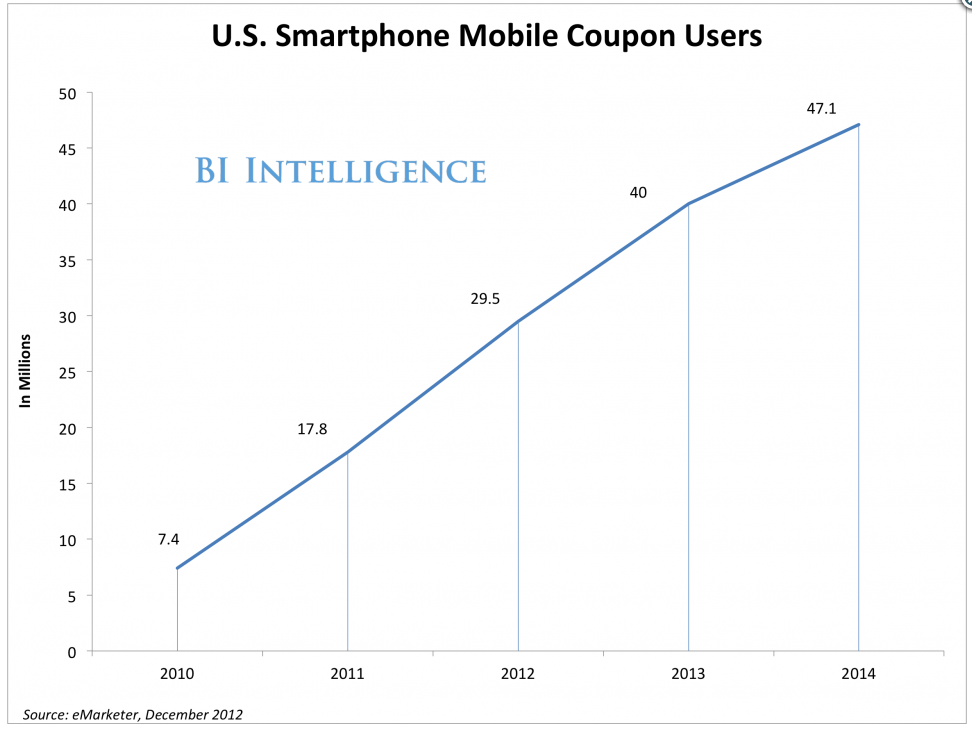
Interesting new “Cheapskates Online: How the 'New Normal' Takes Advantage of New Technology” report from eMarketer. I prefer savvy shoppers over cheapskates but names aside the report is interesting. I like this chart.

While penetration is slowing there is still some growth in digital coupon use and that use is going mobile.

There's room to grow in this market.
Posted in Deals, Marketing, Mobile |
Over on the Nebo blog Kevin Howarth is doing a series of interviews that feature marketing thought leaders both locally and nationally. Kevin was gracious to ask me to participate and we had a fun conversation about interactive marketing. Kevin's interview, with much better graphics than FoG, is being republished here with permission.
What do you feel is the most important aspect of how interactive marketing has developed over the last few years?
Interactive marketing has transitioned from command and control to a more user-generated focus. For any online marketer to be successful, they have to embrace user-generated content and online communities. That means empowering communities to help them spread the word about a company’s products and services. This kind of focus has led to a heavier emphasis on customer service. If you don’t have happy customers, then they’re not going to talk about you. Or they’re going to say bad things. The vast majority of good marketers understand that they are no longer 100% in control. Five years ago, people really didn’t understand this lack of control but I think they understand it now.
How is search and interactive marketing impacting how companies start up their businesses today?
It’s where they start. When a company begins, all they have are themselves and some word of mouth elements. An online presence via social is the least expensive way to amplify what you’re trying to do. SEO and SEM are obviously very important as core aspects to any technology company’s marketing. For example, at Half Off Depot we’ve seen that the way local merchants used to go to market has gone away. The Yellow Pages, local magazines and newspapers are gone or in steep decline, and merchants need a way to market online. We help them with the online piece so that they stay in front of their customers face-to-face.
Companies also have to figure out where “home” resides. Home might be their webpage, or it might be a Facebook page. Either way, companies really have to integrate social from the start while building this “home” presence. Website design has really started to emerge as a competitive advantage. For example,Fab.com is a beautifully designed site, and they actually used design to demonstrate how they’re going to be different from competitors. I don’t think people talk enough about the importance of good design or take into consideration how it can really impact the customer experience. In turn, customer experience can impact word of mouth and viral marketing.
What’s your current assessment of the Atlanta marketing community?
In my opinion, Atlanta is very strong from a technology marketing perspective. But we do a bad job letting the world know about it. We have established well-known companies like MailChimp and WhatCounts, and there are a number of email service providers like Silverpop. There are also quite a few companies starting to play in the social space, and we still have a strong cluster of traditional interactive marketing companies. Atlanta marketers have such deep domain knowledge of interactive marketing that it’s inevitable that they’re starting to apply that knowledge into different verticals and new emerging areas. At its core though, Atlanta is best at B2B. Even the more well-known consumer-focused companies have a heavy B2B bent, and a lot of Atlanta’s marketing companies direct their energies toward that demand.
You’ve mentioned social quite a few times. Why is social so important in today’s marketing climate?
The opportunity for social is understated. Everything is eventually going to be that way. Today, my teenage children cannot imagine a world without the Internet, and they are part of a demographic completely immersed in social. I think marketing is eventually going to become all social, and social is going to be one of the primary marketing drivers as other traditional mediums continue to fragment.
And how does mobile play into the mix?
Social is big, but mobile is the future. Anything that you wanted to do on a computer five years ago, you can now do on a three by six inch device. Today, I think it’s still a little bit difficult to do ecommerce on a mobile device, but that’s quickly going away. Behaviorally, people are not afraid to buy things on a device. It’s just hard to do sometimes because of the initial set up and ease of use, but that’s all going to get solved. For example, Square is making it easier for phones to accept credit cards, and local Atlanta startups such asWhisper Communications are also emerging into this space to help make B2B mobile transactions easier and more secure.
What are your thoughts about how marketing measurement has changed over the years?
If you look at one of the primary drivers of why interactive marketing is growing so quickly, it’s because people are spending more and more time online. That’s half of the equation. The other half is that interactive marketing is much more efficient than traditional marketing from a structural perspective. Not only is it less expensive online versus offline, but you can very accurately measure the effectiveness of what you’re doing in real dollars and cents. More and more companies are demanding that kind of measurement, and I see that trend continuing as audiences fragment and spend more time online.
How does content strategy fall into the marketing mix?
Content is king again, but it’s not necessarily because the content is truly unique. It’s because it will drive traffic to your site. You need good, strong, consistent, and deep content in order to effectively drive traffic. You’ve got to give people the content they want, in the format they want, at the price they’re willing to pay, and when they want it. There are many different variables, but the people who are successful at putting those things together are really good at getting people to buy their products and services.
What marketing trends do you feel will have the most impact in 2012?
Marketing spend will continue to follow people. People are spending much more time on the Internet than they did in the past, and marketing dollars have yet to completely follow that trend. Marketing dollars will continue to go where the people go. Right now, people are on social and I see that trend continuing for the foreseeable future until the next “social” emerges. I often talk about how there were the PC wars, the browser wars, the search engine wars, and the social wars. We had winners in each one of those categories. I don’t know what the next war is. But there is going to be something that pops up that’s truly disruptive and that no one’s really thought about. Consumers will interact with technologies in ways that we can’t even think about right now.
Posted in Internet, Marketing, Mobile, Social |
That is my first impression of the iPhone 4S. It has a really really hard hand compared to my relic iPhone 2G. That and a great camera and external speaker set. Perhaps more when the initial sync finishes. It is amazing how much value Apple packs in a device.
Posted in Mobile |
This article by Henry Blodget for Business Insider and the below chart got me thinking about the smartphone market.
Some quick thoughts.
All the leading smartphones have been integrated software/hardware solutions. Blackberry/Treo/iPhone. The PC model does not work in the smartphone market.
That Android OS bar is going to get a lot more orange.
Apple will not be reduced to niche status.
HTC has a big problem.
Microsoft needs to make a move.
Posted in Business, Mobile |
After giving eMarketer a bit of a backhanded complement yesterday on the online marketing opportunity today they are getting all out kudos.
Location based marketing has been of great interest to me for a while as evidenced by "The Mother of All Internet Wars" and "The Local Nut" articles. Well today eMarketer came out with an article entitled "Online Lures Local Ad Dollars."
This chart does a nice job of showing how local ad spending is expected to continue to shift online to move more in line with now people are spending their time.

The money quote was in the eMarketer Daily.
"The proliferation of online advertising channels over the past few years has made it easier for local businesses to transition ad dollars from pricier, traditional ad formats to cost-efficient interactive channels like social media, search and email marketing."
As online local marketing channels continue to grow and offline marketing channels contine to shrink it's a trend that is sure to continue.
Posted in Internet, Marketing, Mobile, Social |
I have been tinkering around in mobile marketing space for awhile. Really more at the intersection of mobile, flash marketing, location-based services, and social spaces. It's a big intersection. What got me going on it was a mom named Anne that came up with a rather simple solution to a couple of the problems facing flash marketing deal of the day companies like GroupOn.
GroupOn is killing it. Forbes called Chicago based GroupOn the fastest growing company ever. The way a GroupOn deal works is they offer a deal per day in a host of cities via email. It's typically 50% off. The consumer pays for the deal up front. GroupOn keeps 50% of that payment and distributes the other 50% to the retailer over a period of time. Boom, instasales. But the GroupOn concept has some problems.
If you spend anytime talking to merchants these problems come up pretty quick. Retailers don't really like the economics of the deal, they are only getting 25% of their normal retail price. And while GroupOn sells the deal as a customer acquisition method, most retailers feel that the customers don't come back. As one merchant put it to me "people that use coupons are people that use coupons." They even have a derogatory term for them, groupies. Here is a nice little merchant horror story.
If you spend some time on these deal of the day services as a consumer you also notice a few issues. One is certain types of services companies can not keep up with demand when they run a deal. As an example I purchased $175 car detail for $59 from Atlanta based Half Off Depot on April 29. Shortly thereafter I contacted the establishment to arrange an appointment. When I called the number on the coupon I was told that I could not make an appointment via phone though that was the only contact method on the coupon. So I asked for the email address and wrote a note. When I emailed I received an auto reply saying it would be 7 - 10 days before someone got back with me. When they finally did the appointment was set on September 12. Four months after I purchased the deal. When they came out to do the job they were only there for about 45 minutes. I am not alone. These types of stories abound. And worse. Yesterday TechCrunch reported how a fraudulent GroupOn deal in Atlanta really brought the service drawbacks to light.
Anne had the solution to these problems and a couple of other issues that I will keep in my pocket for now. Regardless somebody is going to figure this out and make a lot of money. It could very well be GroupOn, they have some smart people and raised $135 million. That somebody could also be another little Atlanta deal of the day company called ScoutMob. ScoutMob is more of a mobile app than email service. They push virtual coupons to Androids and iPhones. ScoutMob's business model is a bit different. Instead of having consumers paying up front they pay when the redeem the coupon. And without reveling how the business works the economics to the retailer are much more attractive. ScoutMob has solved the issues with flash marketing outlined above. There are about a dozen other startups in Atlanta tackling the space. Currently of note beyond Half Off Depot and ScoutMob are ClipZone, Extrafeet, iCouponBook, OfficeArrow, PlacePunch, SparkSpree, and Thanks Again. There is one in stealth that could get really interesting.
It's a big busy intersection.
Posted in Internet, Mobile |
The hordes waiting in line for hours today to get that new iPhone 4 make it hard to believe that Apple is losing share in the smartphone market. But as I wrote last week, they are and they will continue to do so. Those hordes are merely trading up, not increasing iPhone share one bit.
In the comments of that post, Stephen Fleming, my boss, noted this:
I don't disagree that Android, in its many variations, may dominate MARKET share of smartphones a few years from now. But, with all the revenue streams from iTunes, the App Store, the iBooks store, and iAds, I think Apple will continue to dominate the PROFIT share. And that's what Jobs is targeting this time around.
Stephen is right. He's right because it's not really about the phone because the phone is no longer a phone.
Tell you a story.
About eight to ten years ago I was the guy that started and ran EarthLink's mobile business. The Internet was just beginning to move off the desktop into handhelds and there was a big rush to get there. Companies such as AventGo and Everypath promised to get web content into the mobile environment. There was just one problem with this plan. Well maybe two. Back then wireless transit speeds were extremely limited. Viewing any content was painful. Very painful, nobody had the patience. But the bigger issue was that users did not even want content on their mobile devices. They wanted what got them to use the Internet in the first place. Communications. Email. The handheld, that is what we called them back then, needed to morph to a communications device not a content device. So we went out and built that capability, sold it to our installed customer base, and built a nice little business around it.
Fast forward to 2007. The launch of the iPhone 2G. Why they called the 1st generation phone a 2G when all other Apple handhelds use the numeric before the G to designate generation is beyond me. But I digress. The iPhone was not a phone. It was something. A platform. At the time what exactly it was a platform for was unclear. But if you used one a little voice deep inside was telling you "this changes everything."
And what is becoming clear in 2010 is what it changes. The iPhone is not a phone. Yeah it does all that communications stuff like email, talking, texting, and more. But it does something else, and it does it pretty darn well. It delivers content. Hell it creates content. The iPhone has made the jump from being a communications device to being a content device. It's the only thing out there like it, which is why the hordes are waiting in line to upgrade. And even more importantly, delivering content can be a very big and profitable business even if the iPhone becomes a niche player in the smart phone market.
Posted in Current Affairs, Internet, Mobile |